Free, practical guides written by our training team — from manual handling and lifting technique to fire safety, first aid and food hygiene. Learn the essentials, then get certified in minutes.
Our online safety courses are benchmarked to the requirements of:

Manual handling is one of the largest single causes of workplace injury in Ireland. The damage rarely arrives in a dramatic moment — far more…
Read article →
Skipping manual handling training feels like a saving — right up until the day it is not. In Ireland, ignoring your duties can lead to enforcement…
Read article →
Manual handling is one of the most heavily regulated everyday activities in the Irish workplace. This article explains the law clearly: where the…
Read article →
Manual handling injuries remain one of the most common causes of lost working days in Ireland. This guide explains what manual handling really…
Read article →
It is the single most common question employers ask us: how many kilograms can a worker legally lift in Ireland? The honest answer surprises…
Read article →
In a warehouse, a box stays where you put it. In a care home, the "load" can be frightened, in pain, unpredictable — and a human being who…
Read article →
Few sectors lift, lower, push and pull as relentlessly as warehousing and logistics. A single picker can handle thousands of items in a shift, and…
Read article →
Most back injuries at work come from one bad lift or a thousand careless ones. The good news is that a safe lift follows a simple, repeatable…
Read article →
TILE is the four-letter checklist that turns a vague worry about a heavy job into a clear list of risks you can act on. Standing for Task,…
Read article →
Ladders are the most common access equipment in Ireland and the most commonly misused. Used correctly, for the right task, they are perfectly…
Read article →
Stopping a fall is always better than catching one. This guide walks through the hierarchy of control for work at height in Ireland — from…
Read article →
Part 4 of the General Application Regulations is the heart of Irish work-at-height law. Here is what it covers, who has to comply, and how the…
Read article →
From roofers and scaffolders to warehouse staff on a stepladder, anyone who could fall and be injured is working at height. Here is what the…
Read article →
Abrasive wheel accidents are rarely freak events. They follow recognisable patterns — a wheel run too fast, a missing guard, no eye protection,…
Read article →
Angle grinders and bench grinders are some of the most useful tools on any Irish site or in any workshop — and some of the most dangerous. This…
Read article →
There is no single "Abrasive Wheels Regulation" in Irish law. Instead, the duties sit inside the wider health and safety framework — the Safety,…
Read article →
Most serious abrasive wheel failures trace back to how the wheel was fitted, not how it was used. Mounting a wheel correctly is a precise sequence…
Read article →
Asbestos is still present in thousands of Irish buildings constructed before its ban. For anyone whose work could disturb it, awareness training…
Read article →
Asbestos may be banned from new use, but the diseases it causes are still being diagnosed today — often decades after a single, half-forgotten…
Read article →
From risk assessment to exposure limits and notification, Irish asbestos law sets out exactly what employers must do to protect workers. This…
Read article →
Not all fires are the same — and the agent that puts one out can make another far worse. Fires are grouped into classes by the fuel that feeds…
Read article →
Fire safety in Ireland is not a matter of best practice — it is the law. Get it wrong and you face inspections, enforcement notices, closure…
Read article →
Fire is one of the few workplace hazards that can destroy a business in minutes and put lives at risk in seconds. For Irish employers, managing…
Read article →
A fire extinguisher is useless if you freeze when you need it. The good news: there is a simple, four-step method that anyone can remember under…
Read article →
When the alarm sounds, someone has to keep a cool head, get people moving and make sure no one is left behind. That someone is the fire warden —…
Read article →
Cardiac arrest can happen anywhere, and the people nearby make the difference. Here are the CPR and defibrillator basics everyone should know,…
Read article →
Every Irish workplace has a legal duty to provide first aid. Here is what Part 7 of the General Application Regulations actually asks of…
Read article →
Irish law sets no fixed ratio of first-aiders to staff. The right number comes from a risk-based needs assessment of your own workplace. Here is…
Read article →
Stress, anxiety and burnout affect workers in every sector. Mental health first aid helps teams spot the signs early and signpost support, and it…
Read article →
The wrong PPE is sometimes more dangerous than none at all, because it creates a false sense of safety. Selecting the right equipment means…
Read article →
Personal protective equipment is one of the most visible parts of workplace safety, yet it is also the most misunderstood in law. In Ireland, PPE…
Read article →
One of the most chilling facts in workplace safety is that a large share of people who die in confined spaces are not the original workers — they…
Read article →
When entry into a confined space cannot be avoided, the only thing standing between a worker and serious harm is a properly planned safe system of…
Read article →
A confined space is not defined by its size. A large tank or a long sewer can be a confined space, while a small cupboard may not be. What matters…
Read article →
A manual handling risk assessment is the practical heart of Irish health and safety law. It turns the legal duty to assess risk into a real-world…
Read article →
A written risk assessment is the foundation of every compliant Irish workplace. Here is a plain-English guide to what it is, the legal duty behind…
Read article →
Risk assessment becomes simple once you break it into five clear steps. Here is the proven Irish method — identify hazards, decide who is at risk,…
Read article →
Every employer in Ireland must have a written Safety Statement. Here is exactly what it is, what the law requires it to contain, who needs one,…
Read article →
For some customers, a single overlooked ingredient is not an inconvenience but a medical emergency. Irish food law sets out exactly which…
Read article →
Temperature is the single most powerful tool you have against harmful bacteria. Keep food cold enough, cook it hot enough, and you stop the…
Read article →
Run a food business in Ireland and you sit inside a clear framework of responsibility, watched over by the FSAI and enforced on the ground by…
Read article →
HACCP can sound like a mountain of paperwork, but the idea behind it is simple: find the points where food could become unsafe, and put a check in…
Read article →
Irish and EU law expects food handlers to be trained to a level that matches their job. For most catering staff that means Level 2 — here is exactly what it covers…
Read article →
The people preparing food are one of the biggest sources of contamination in any kitchen. Good personal hygiene is the simplest, cheapest barrier a food business has…
Read article →
A kitchen can look spotless and still be dangerous. Cleaning removes what you can see; disinfection kills what you cannot. Knowing the difference is a core skill…
Read article →
Most food safety problems are made or avoided in storage, long before anything reaches the pan. Get temperature, separation and stock rotation right and you stop bacteria…
Read article →
Food poisoning is almost always preventable. It comes from a short list of causes, and each has a well-understood control. Learn the causes and the controls…
Read article →
Compliance is the floor, not the ceiling. A genuine safety culture is what keeps Irish workplaces safe day to day. Here is how to build one…
Read article →
One platform to train your staff, store every certificate and track compliance at a glance. Here is what to look for in an online safety training…
Read article →Self-paced, HSA-aligned, available in 20 languages. Pass the short assessment and download your certificate the same day — valid for around three years.
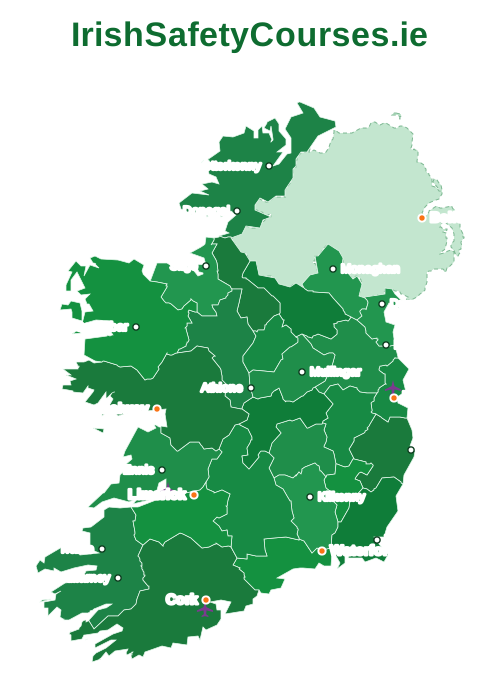
Take your course online from Dublin, Cork, Galway, Limerick, Waterford, Sligo - or any town in Ireland. Learn at your own pace on any device, and finish with an instant HSA-aligned certificate that's accepted in every county, nationwide.
We use strictly necessary cookies to make this website work. With your consent we also use analytics cookies to understand how the site is used and improve it. You can accept all, reject non-essential cookies, or set your own preferences. Read our Cookie Policy.