Working at Heights: The Complete Irish Guide
From roofers and scaffolders to warehouse staff on a stepladder, anyone who could fall and be injured is working at height. Here is what the activity actually covers in Ireland, why it remains one of the deadliest hazards at work, and what the law expects of you.
What counts as working at height?
Working at height is one of the most misunderstood terms in workplace safety. Many people assume it only applies to construction sites, scaffolds and tall buildings. In reality, the definition is far broader. In Ireland, work at height means any work where, if precautions are not taken, a person could fall a distance liable to cause personal injury.
Crucially, there is no minimum height in the legislation. A fall from a kerb-height platform into an open pit can be just as serious as a fall from a roof. That is why activities people rarely think twice about are caught by the rules, including:
- Standing on a ladder, stepladder or hop-up to reach shelving or fittings
- Working on flat or pitched roofs, gutters and skylights
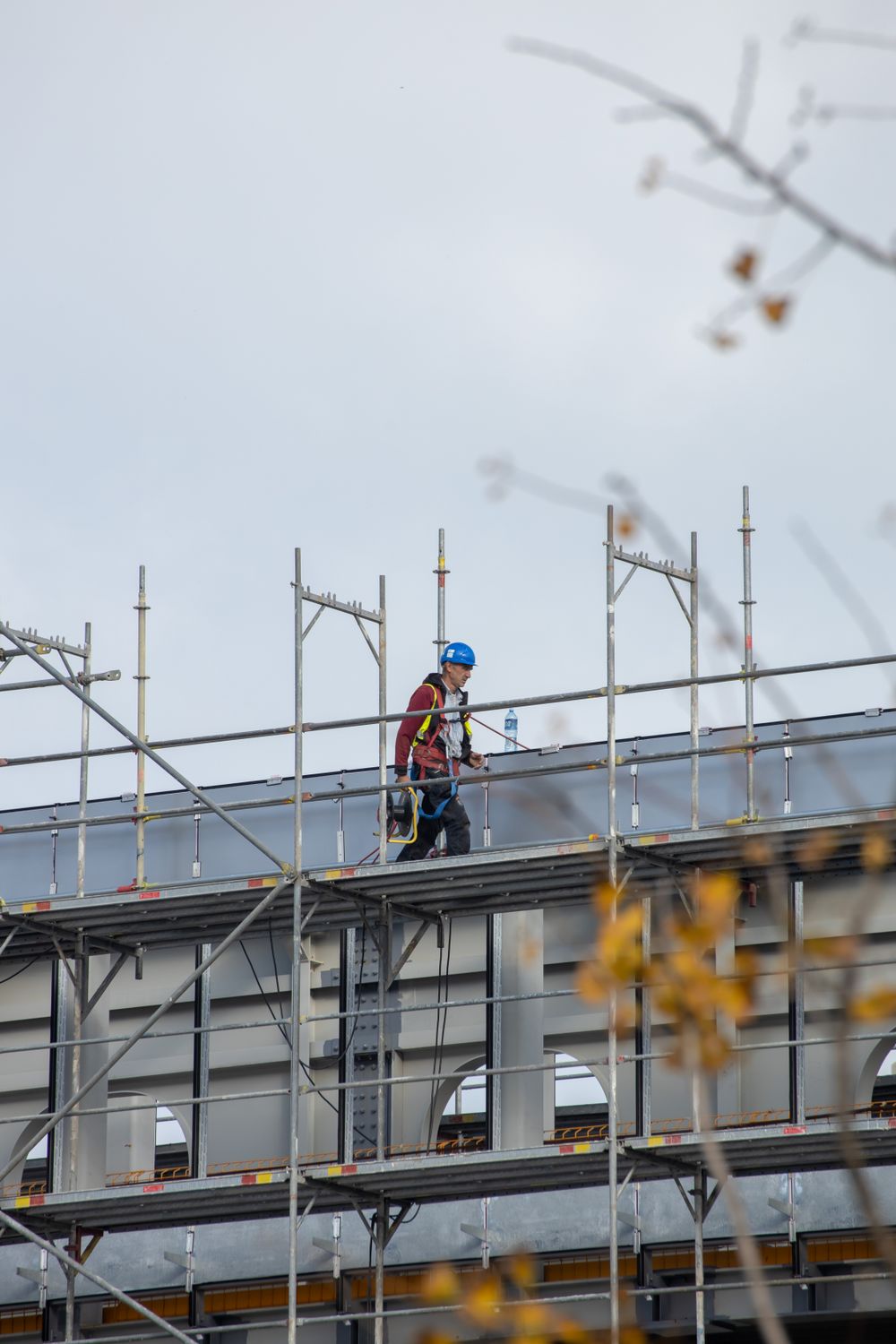
- Using scaffolding, towers or a mobile elevating work platform (MEWP)
- Working near an unprotected edge, opening, or fragile surface
- Loading and unloading vehicles where a person could fall from the deck
If a person could fall and be hurt, you are dealing with work at height, and the legal duties below apply.
Why falls remain a leading cause of workplace death
Falls from height are consistently among the most common causes of fatal and serious workplace injury in Ireland. The Health and Safety Authority (HSA) regularly identifies falls as one of the leading killers across agriculture, construction and general industry. The reason is simple: gravity is unforgiving, and the time between a slip and an impact is too short to react.
What makes these incidents so frustrating is that they are almost always preventable. They tend to follow a small number of recurring patterns: a ladder that was not footed or tied, an unguarded roof edge, a fragile rooflight that gave way, or a task that was rushed because "it would only take a minute". The severity is rarely in proportion to the height.
The most dangerous fall is the one nobody planned for, because the task seemed too small to bother with a plan.
Working at Heights training from €35
Self-paced, HSA-aligned, certificate the same day — €35 per person.
The law in Ireland
Two pieces of legislation set the framework. The Safety, Health and Welfare at Work Act 2005places a general duty on every employer to ensure, so far as is reasonably practicable, the safety, health and welfare of employees. Specific to falls, the Safety, Health and Welfare at Work (General Application) Regulations 2007, Part 4 deals directly with Work at Height.
Part 4 builds everything around a clear order of priority known as the avoid–prevent–minimise hierarchy:
- Avoid work at height altogether where it is reasonably practicable to do so.
- Prevent falls by using the right equipment and a safe place of work, such as guardrails or a fully boarded platform.
- Minimise the distance and consequences of a fall where the risk cannot be removed, for example with collective measures like nets or, as a last resort, personal fall-arrest systems.
The legislation also requires that work at height is properly planned and organised, that it is carried out by competent people, and that the equipment used is suitable, inspected and maintained. You can read more in our guide to Part 4 of the 2007 Regulations.
Training and certification
Competence is a legal requirement, not a nice-to-have. The 2005 Act expects employers to provide the information, instruction and training employees need to work safely. For work at height, that means workers understand the hazards, can carry out pre-use checks, know how to select and use access equipment correctly, and recognise when a task should be stopped.
Good training gives your team a shared language for risk and a clear sense of when to escalate. It also gives you, as the employer, documented evidence that you have met your duty to inform and instruct, which matters if the HSA ever asks.
Key takeaways
- Work at height is any work where a person could fall and be injured — there is no minimum height.
- Falls remain one of the leading causes of workplace death in Ireland, and nearly all are preventable.
- The 2005 Act and Part 4 of the 2007 Regulations set your duties, built on avoid–prevent–minimise.
- Work at height must be planned, carried out by competent people, and use inspected equipment.
- HSA-aligned training is the simplest way to prove competence — our course is just €35.
Getting your team certified
Our online Working at Heightscourse is self-paced and HSA-aligned, covering the law, the hierarchy of control, equipment selection, inspection and rescue planning. Learners complete a short assessment and download a certificate the same day, so there is no waiting and no classroom day lost. For organisations training several people, bulk pricing brings the cost per learner down further. Pairing this with our guidance on preventing falls from height gives your team both the theory and the practical mindset to stay safe.