Preventing Falls From Height: The Hierarchy of Control
Stopping a fall is always better than catching one. This guide walks through the hierarchy of control for work at height in Ireland — from designing the risk out, to collective protection, to personal fall arrest — and explains why no plan is complete without a way to rescue someone.
Start with the hierarchy
Every decision about preventing falls in Ireland flows from one principle, set out in Part 4 of the Safety, Health and Welfare at Work (General Application) Regulations 2007 and underpinned by the Safety, Health and Welfare at Work Act 2005: the avoid–prevent–minimise hierarchy. You work down it in order and only move on when the step above is not reasonably practicable.
- Avoid work at height where you can, by doing the task from the ground or designing it out.
- Prevent falls where work at height is unavoidable, using a safe place of work and collective protection.
- Minimise the distance and consequences of a fall where some risk remains, with collective measures first and personal protection last.
The hierarchy is the backbone of our wider guide to Part 4 of the 2007 Regulations, and it is worth understanding why the order matters so much.
Collective versus personal protection
The most important distinction in fall prevention is between collective and personal protection, because the law strongly prefers the former.
Collective protection protects everyone in the area without anyone having to do anything. A guardrail keeps every worker on a platform safe whether or not they remember to clip on. It is passive, hard to defeat, and requires no individual skill in the moment.
Personal protection, such as a harness and lanyard, only protects the one person wearing it, and only if it is correctly fitted, anchored and used every single time. It depends on the user, which makes it less reliable.
Collective measures protect people who forget. Personal measures protect only people who remember. That is why the law puts the rail before the harness.
Preventing falls: guardrails and MEWPs
The first line of defence, once you cannot avoid the work, is a safe place of work that physically prevents a fall.
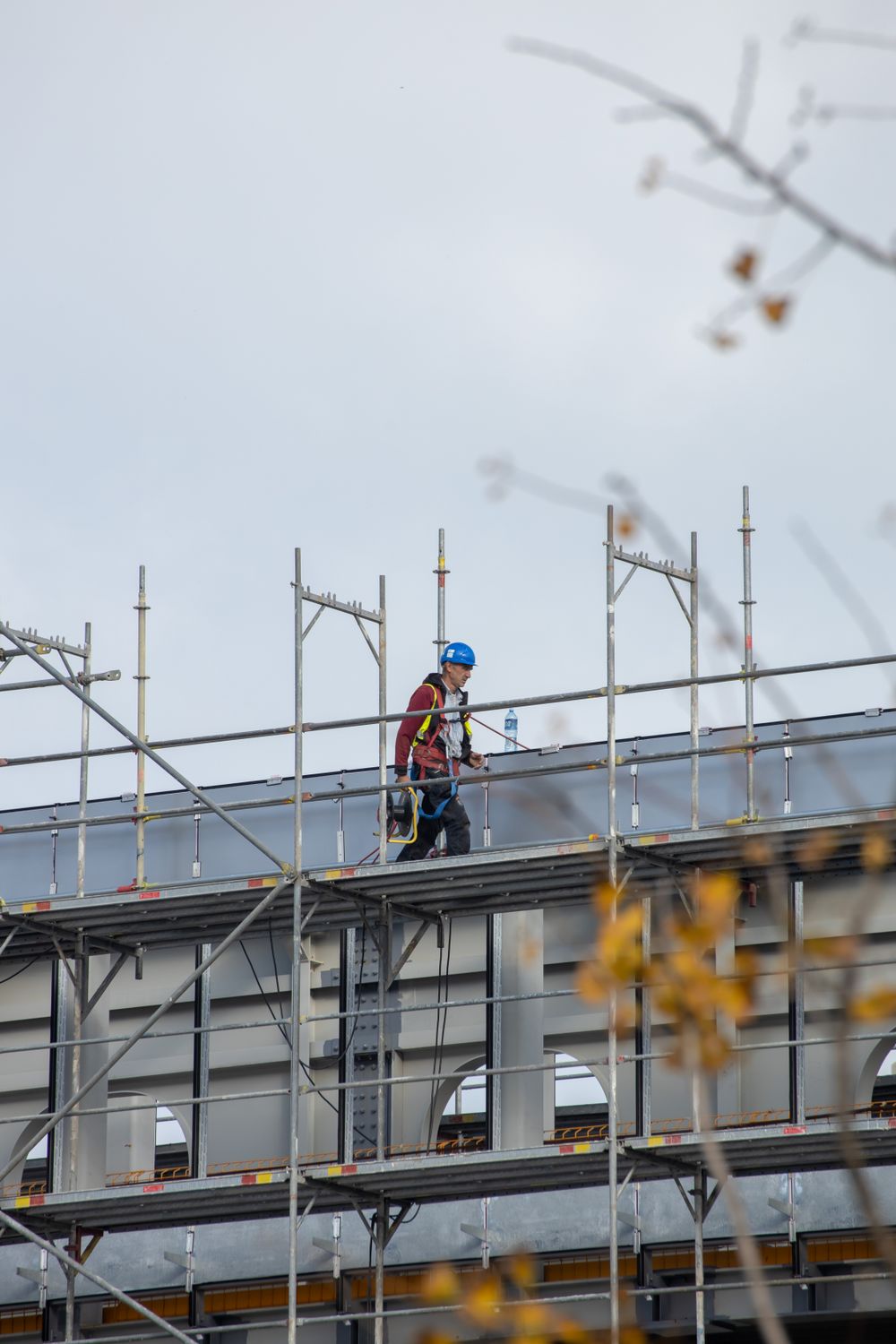
- Guardrails and edge protection are the classic collective measure: a top rail, intermediate rail and toe board around an open edge, on a roof, platform or scaffold.
- Fully boarded working platforms, towers and podium steps give a stable surface with built-in protection.
- Mobile elevating work platforms (MEWPs), such as scissor and boom lifts, raise workers in a guarded basket, keeping them enclosed throughout. They are well suited to short-duration or awkward access work that a ladder cannot handle safely.
Whatever you choose, it must be suitable for the task, set up by competent people, and inspected. For lighter, low-risk access, see our piece on ladder safety at work.
Working at Heights training from €35
Self-paced, HSA-aligned, certificate the same day — €35 per person.
Minimising the fall: nets and fall arrest
Where a fall cannot be fully prevented, the next step is to reduce how far someone falls and how badly they are hurt. Again, collective measures come first.
- Safety nets are a collective minimise measure. Rigged close beneath the work, they catch a falling worker and limit the fall distance, protecting everyone in the area without relying on individual action.
- Fall-arrest systems — a full-body harness connected to a secure anchor by a lanyard or inertia reel — are the last resort. They do not prevent a fall; they stop it after it has begun, which means the worker still experiences the fall and its forces.
Fall arrest only works if the anchor is strong enough, the system is correctly fitted, there is enough clearance below to arrest the fall before the worker hits anything, and the user is trained. It should never be chosen simply because it is quicker to deploy than a guardrail.
Why rescue planning is essential
This is the step most often overlooked. If a worker falls and is left hanging in a harness, they are not safe — they are in danger. Prolonged suspension can cause serious harm in a relatively short time, so a person in fall arrest must be recovered quickly.
That is why any plan involving fall-arrest equipment must include a rescue plan that does not rely on the emergency services arriving in time. Your plan should cover:
- How a suspended person will be reached and lowered or recovered, and with what equipment.
- Who is trained and available on site to carry out the rescue.
- How the alarm is raised and how long recovery is expected to take.
- Regular practice so the plan works under real pressure, not just on paper.
A fall-arrest system without a rescue plan is only half a control measure.
Key takeaways
- Always work down the avoid–prevent–minimise hierarchy in order.
- Prefer collective protection (guardrails, nets) over personal protection (harnesses).
- Guardrails, platforms and MEWPs prevent falls; nets and fall arrest only minimise them.
- Fall arrest is a last resort and needs a strong anchor, clearance and training.
- No fall-arrest plan is complete without a rehearsed rescue plan.
Train your team to think this way
Choosing the right control measure is a judgement your team makes on every job. Our online Working at Heightscourse teaches the hierarchy of control, collective and personal protection, equipment selection and rescue planning, so your people reach for the rail before the harness. It is self-paced, HSA-aligned and just €35, with a certificate issued the same day. For the full picture, start with our complete Irish guide to working at heights.