
Abrasive Wheels Training: The Complete Irish Guide
Angle grinders and bench grinders are some of the most useful tools on any Irish site or in any workshop — and some of the most dangerous. This guide explains what abrasive wheels are, why they carry such a high risk, the legal duty to train the people who use them, and exactly what a good course should cover.
What is an abrasive wheel?
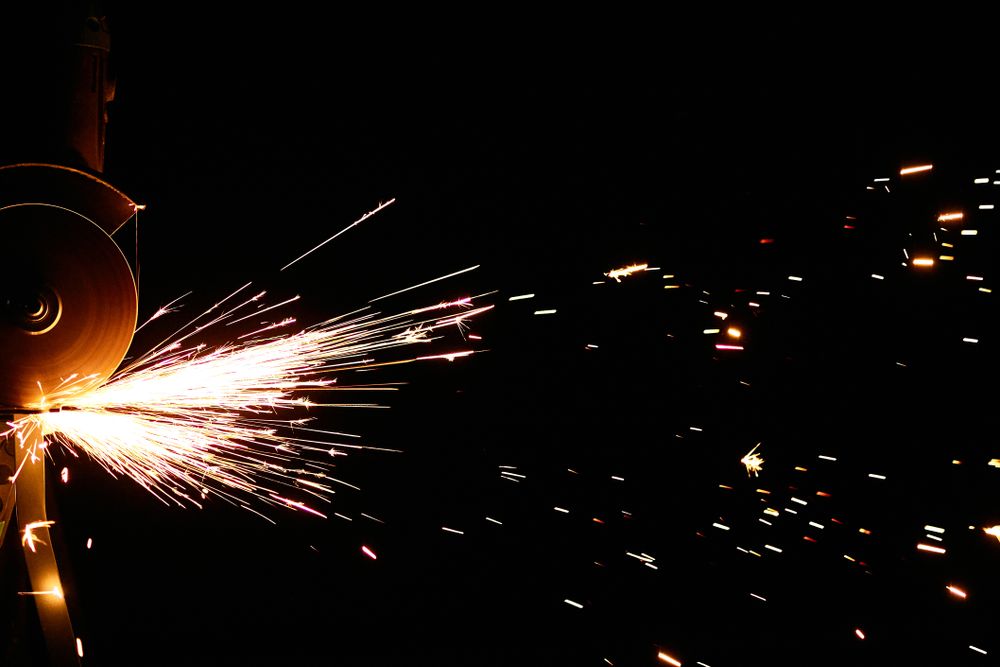
An abrasive wheel is a cutting or grinding tool made from bonded abrasive grains that spins at very high speed to cut, grind, sand or polish material. The category covers far more than the bench grinder in the corner of the workshop. It includes angle grinder discs, cutting-off wheels, flap discs, diamond blades, mounted points and the larger fixed wheels found on pedestal and surface grinders.
What unites all of them is energy. A typical 230 mm angle grinder disc can turn at well over 6,000 revolutions per minute, which means the rim of the wheel is travelling at roughly 80 metres per second. That stored energy is what makes the tool work — and what makes a failure so violent.
Why abrasive wheels are high-risk
Abrasive wheels are unusual among hand tools because the consequences of a single mistake can be severe and immediate. The main hazards are well understood:
- Wheel breakage. If a wheel is run faster than its rated speed, is mounted incorrectly, is cracked, or is twisted in the cut, it can shatter. Fragments leave the wheel at the rim speed and can travel a considerable distance.
- Contact and kickback. The exposed part of a spinning wheel can cause deep lacerations in a fraction of a second. Kickback — where the tool jumps back at the operator — is a frequent cause of injury with angle grinders.
- Eye injuries. Sparks, grit and small fragments are thrown out continuously during grinding and cutting.
- Dust and vibration. Cutting concrete, stone or metal generates harmful dust, including respirable crystalline silica, while prolonged use exposes operators to hand-arm vibration.
- Fire and sparks. The shower of hot sparks is a genuine ignition source near flammable materials.
The hazard is not the operator's skill with the tool — it is the speed and energy of the wheel itself. Even an experienced tradesperson can be seriously hurt by a wheel that was mounted or selected incorrectly.
The legal duty to train
In Ireland, the obligation to train people who use abrasive wheels flows from the Safety, Health and Welfare at Work Act 2005. The Act places a general duty on every employer to ensure, so far as is reasonably practicable, the safety, health and welfare of employees — and that explicitly includes providing the instruction, training and supervision necessary to do the work safely.
This is reinforced by the work-equipment provisions of the Safety, Health and Welfare at Work (General Application) Regulations 2007. Those Regulations require that work equipment is suitable for the task, properly maintained, and used only by people who have received adequate information and training. An abrasive wheel is work equipment, so a worker who mounts, changes or operates one needs to be competent to do so.
The Health and Safety Authority (HSA) is the regulator in Ireland, and inspectors expect to see that operators have been trained and that records exist to prove it. Training is not a box-ticking exercise — it is the practical way an employer meets a duty they already hold in law.
Abrasive Wheels training from €35
Self-paced, HSA-aligned, certificate the same day — €35 per person.
What an abrasive wheels course covers
A worthwhile abrasive wheels course does more than warn people to be careful. It builds the knowledge an operator needs to select, mount and use a wheel without putting themselves or others at risk. A typical syllabus includes:
Wheel selection and marking
How to read the information on a wheel — the type, the bore, the maximum operating speed and the expiry where relevant — and how to choose the correct wheel for the material and the machine.
Inspection and the ring test
How to inspect a wheel for cracks and damage before fitting, including the ring test for vitrified wheels, and how to store wheels so they are not damaged in the first place.
Mounting and speed matching
Correct use of flanges and blotters, ensuring the spindle speed never exceeds the maximum speed marked on the wheel, and the importance of a controlled test run before work begins.
Guarding and PPE
Setting the guard so it deflects fragments away from the operator, and selecting the right personal protective equipment — eye protection, hearing protection, respiratory protection and gloves where appropriate.
Key takeaways
- An abrasive wheel stores enormous energy at high speed, so a single mounting or selection error can cause serious injury.
- The Safety, Health and Welfare at Work Act 2005 and the General Application Regulations 2007 require trained, competent operators.
- The HSA expects employers to keep records showing operators have been trained.
- A good course covers selection, inspection, mounting, speed matching, guarding and PPE.
- You can certify your team online from €35 per person, with the certificate available the same day.
Who needs abrasive wheels training?
Anyone who selects, mounts, changes or operates an abrasive wheel as part of their work should be trained. That covers a wide range of roles: construction and demolition workers, fabricators and welders, fitters and maintenance crews, stonemasons, motor mechanics and groundworkers. Supervisors who oversee this work also benefit, because they need to recognise unsafe practice when they see it. If your role involves an angle grinder or a bench grinder even occasionally, the training applies to you.
Getting your team certified
Our online Abrasive Wheels course costs €35 per personis self-paced and aligned with HSA expectations. Learners work through the material at their own speed, complete a short assessment, and download a certificate the same day. For teams, you can enrol several people at once and keep all the certificates in one place — a simple way to show an inspector that your work-equipment duties are being met. To go deeper, read about your legal duties in Ireland and the practical steps for mounting an abrasive wheel safely. For broader needs, you can also see all our courses.