Abrasive Wheel Accidents: Causes and How to Prevent Them
Abrasive wheel accidents are rarely freak events. They follow recognisable patterns — a wheel run too fast, a missing guard, no eye protection, dust breathed in day after day. Understanding the common causes is the first step to controlling them. Here are the main hazards and the practical measures that prevent harm.
Wheel breakage
The most dramatic abrasive wheel accident is the wheel itself coming apart at speed. When a wheel bursts, fragments are flung outward with great force. The usual causes are predictable:
- Running the wheel faster than its marked maximum speed.
- Fitting a cracked, chipped or previously dropped wheel.
- Incorrect or damaged flanges, or missing blotters.
- Twisting or jamming the wheel in the cut so it is side-loaded.
- Using the wrong wheel for the machine or material.
How to prevent it
Inspect and ring-test wheels before fitting, match the spindle speed to the wheel's maximum, use correct flanges and blotters, and run a test before work. These steps are covered in detail in our guide to mounting an abrasive wheel safely. Always keep the guard in place — it is designed to contain fragments if the worst happens.
Almost every burst wheel can be traced to something that should have been checked before the machine was switched on. Prevention happens at the moment of mounting, not in the cut.
Contact injuries and kickback
A spinning wheel will cut flesh as readily as steel. Contact injuries happen when a hand strays into the exposed part of the wheel, or when an angle grinder kicks back — jumping out of the cut toward the operator. Kickback is especially common when a cutting disc binds or when the operator loses control of a powerful tool.
Controls include keeping both hands on the tool with a firm grip, using the side handle, positioning the body out of the line of a potential kickback, securing the workpiece so it cannot move, and never removing the guard to reach a tight spot. Letting the wheel reach full speed before it touches the work, and letting it stop fully before putting the tool down, also reduce the risk.
Eye injuries
Grinding and cutting throw out a constant stream of sparks, grit and fine fragments. Eye injuries are among the most frequent abrasive wheel incidents and are almost entirely preventable. Suitable eye protection — safety glasses, goggles or a face shield rated for impact — must be worn by the operator and by anyone working nearby. A face shield over safety glasses is sensible for heavy cutting where larger fragments are produced.
Abrasive Wheels training from €35
Self-paced, HSA-aligned, certificate the same day — €35 per person.
Dust and vibration
Not every abrasive wheel hazard is immediate. Two of the most serious harms build up over time.
Harmful dust
Cutting and grinding concrete, stone, brick and some metals releases fine dust. When that dust contains respirable crystalline silica, repeated exposure can cause serious, irreversible lung disease. Controls follow a clear order: cut on-tool extraction or water suppression at the source first, then good ventilation, and respiratory protective equipment as a final layer where exposure remains. RPE must be the correct type and properly fitted to do any good.
Hand-arm vibration
Prolonged use of grinders exposes operators to hand-arm vibration, which over time can lead to hand-arm vibration syndrome (HAVS) — a painful and disabling condition affecting circulation and nerves in the hands. Limit exposure time, use lower-vibration tools where available, keep wheels sharp and well maintained, and rotate tasks so no one operator is on a grinder all day.
Fire and sparks
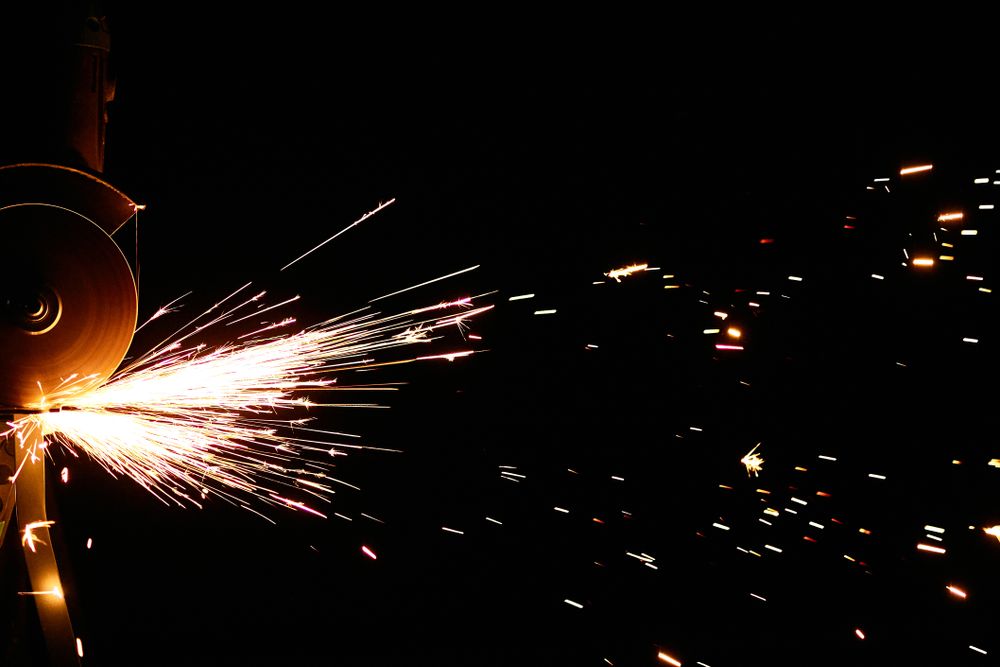
The shower of hot sparks from a grinder is a real ignition source. Sparks can travel several metres and smoulder unseen, so cutting near fuels, solvents, dusts or other combustible materials needs care. Clear the area of flammables, use screens to contain sparks, keep suitable fire-fighting equipment nearby, and where the work qualifies as hot work, follow a permit system with a fire watch maintained after the job finishes.
Key takeaways
- Wheel breakage is caused by over-speeding, damaged wheels and bad mounting — prevent it before switching on.
- Keep the guard fitted, control kickback, and protect the eyes of everyone nearby.
- Control dust at source and limit vibration exposure to prevent long-term harm.
- Treat sparks as an ignition source and manage fire risk around flammable materials.
- PPE and training are the backbone of prevention — certify operators from €35.
The role of PPE and training
Personal protective equipment — eye and face protection, hearing protection, respiratory protection and suitable gloves and clothing — is essential, but it is the last line of defence, not the first. The most effective control is a trained operator who selects the right wheel, mounts it correctly, sets the guard and recognises when something is wrong. Training turns a list of rules into reliable habits.
Our online Abrasive Wheels course costs €35 per personis self-paced and aligned with HSA expectations, and covers every hazard discussed here along with the controls to manage them — issuing a certificate the same day. To see how this fits your obligations, read about your legal duties in Ireland, or browse all our courses.