Food Safety Temperature Control: The Numbers You Must Know
Temperature is the single most powerful tool you have against harmful bacteria. Keep food cold enough, cook it hot enough, and you stop the organisms that cause food poisoning in their tracks. Here are the numbers every food handler in Ireland should know by heart.
Most cases of foodborne illness come down to one of two failures: food that should have been kept cold was left to warm up, or food that should have been cooked or held hot was not hot enough. Bacteria grow fastest in a band of temperatures that food passes through every day, and temperature control is how you manage that risk. It is also a core part of any HACCP-based system and one of the first things an Environmental Health Officer will check.
The danger zone
The danger zone is the temperature range in which harmful bacteria multiply most rapidly: between 5°C and 63°C. Within this band, and especially around body temperature, bacteria can double in number alarmingly quickly. The whole logic of temperature control is to move food through this zone as fast as possible and to avoid leaving it sitting there.
The aim is simple: keep cold food below 5°C, keep hot food above 63°C, and never let food linger in the danger zone in between.
Time matters as much as temperature
Bacteria do not multiply to dangerous levels instantly. It is prolonged time in the danger zone that creates the risk. That is why you chill cooked food quickly rather than leaving it to cool slowly on the counter, and why you do not leave chilled deliveries standing around before putting them away.
Fridge and freezer temperatures
Cold storage is your first line of defence. The targets to remember are:
- Fridge: at or below 5°C. This keeps chilled food out of the danger zone and slows bacterial growth.
- Freezer: at or below -18°C. At this temperature bacteria cannot multiply, although freezing does not kill them. They become active again once food thaws.
Store raw and ready-to-eat foods separately, with raw meat and poultry below ready-to-eat items so nothing can drip down and contaminate them. Do not overload a fridge, as poor air circulation can leave warm pockets.
Cooking temperatures
Thorough cooking is what destroys harmful bacteria. A widely used target is to ensure the core of the food reaches 75°C, or an equivalent time-and-temperature combination that achieves the same level of safety. The core is the thickest part or centre of the food, which is the last point to heat up.
Particular care is needed with higher-risk foods such as poultry, minced meat, burgers, sausages and rolled joints, where bacteria from the surface can be carried into the middle. Always check with a clean, calibrated probe thermometer rather than relying on colour or appearance alone.
Food Hygiene training from €35
Self-paced, recognised, certificate the same day — €35 per person.
Hot holding and reheating
Two more numbers complete the picture, and they catch a lot of businesses out.
Hot holding
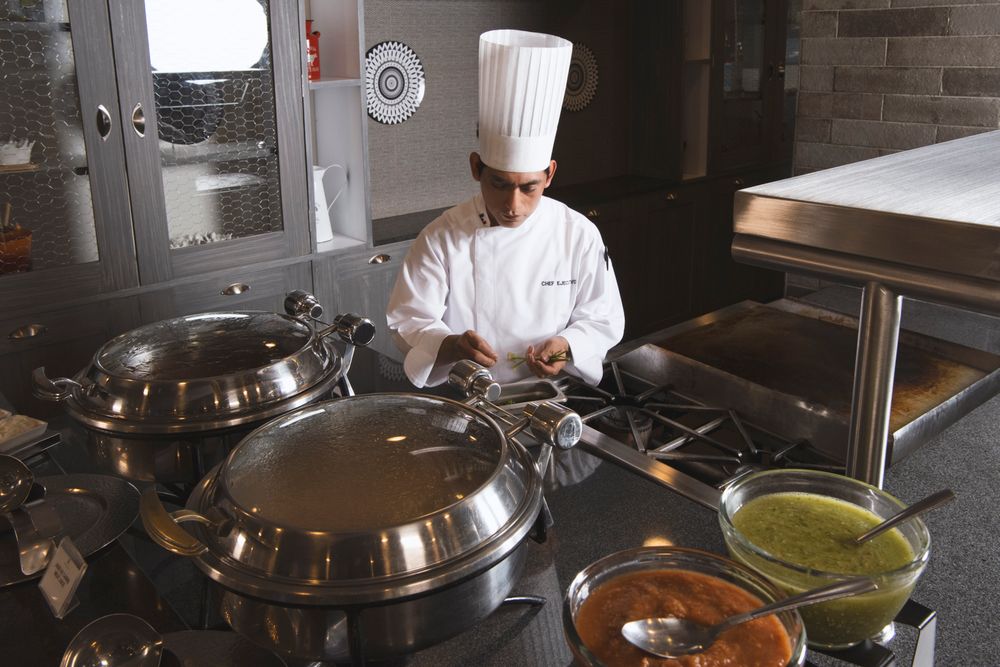
Food that is cooked and then kept hot for service must be held at 63°C or above. A bain-marie, hot cabinet or heated display should be brought up to temperature before food goes in, not after. Hot-held food sitting just below 63°C is drifting straight back into the danger zone.
Reheating
When you reheat previously cooked food, it must be reheated thoroughly so the core reaches a high temperature, commonly taken as at least 70°C, and held there for long enough to destroy bacteria. Reheat food only once. If it is not used, it should be discarded rather than cooled and reheated a second time.
Monitoring and records
Knowing the numbers is not enough; you have to prove you are meeting them. Good monitoring is the backbone of temperature control:
- Check and record fridge and freezer temperatures at regular intervals.
- Probe cooked, hot-held and reheated food and write down the readings.
- Calibrate probe thermometers and clean them between uses to avoid cross-contamination.
- Act quickly on any reading outside the safe range, and record the corrective action you took.
These records are exactly what an Environmental Health Officer expects to see, and they are simple to keep once they become routine. Training every food handler in why these numbers matter, not just what they are, turns temperature control from a chore into a habit. A recognised food hygiene course is a quick, low-cost way to give your team that grounding.
Key takeaways
- The danger zone for bacterial growth is 5°C to 63°C; move food through it fast.
- Keep fridges at or below 5°C and freezers at or below -18°C.
- Cook food so the core reaches 75°C, or an equivalent safe time and temperature.
- Hot-hold at 63°C or above, and reheat thoroughly to at least 70°C, only once.
- Monitor, record and act on temperatures, and train staff in why the numbers matter.
Master these few numbers and the everyday risks in a kitchen become far easier to manage. Cold food cold, hot food hot, the danger zone respected, and a clean probe in hand: that is temperature control in a nutshell, and it is one of the most effective things any food business can do to keep customers safe.