CPR and Defibrillator Basics Everyone Should Know
Cardiac arrest can happen anywhere, and the people nearby make the difference. Here are the CPR and defibrillator basics everyone should know, from DRABC to using an AED.
Cardiac arrest can strike anyone, anywhere, with no warning. When it does, the people standing nearby matter more than almost anything else. Early action in the first few minutes, before professional help arrives, is what gives someone the best chance of survival. That is why a working knowledge of CPR and how to use a defibrillator is something everyone should have, whether or not your job requires formal first-aid training.
This guide explains the basics in plain terms: how to check a casualty using the DRABC approach, how to give chest compressions, and how an automated external defibrillator (AED) works. It is general awareness, not a substitute for hands-on training, but knowing the steps means you are far less likely to freeze when seconds count.
Start with DRABC
When you come across someone who has collapsed, a simple sequence keeps you calm and methodical. The well-known DRABC approach stands for Danger, Response, Airway, Breathing and Circulation.
- Danger — check the area is safe for you and the casualty before you approach.
- Response — gently shake the shoulders and ask loudly if they are all right.
- Airway — if there is no response, tilt the head back and lift the chin to open the airway.
- Breathing — look, listen and feel for normal breathing for up to ten seconds.
- Circulation — if they are not breathing normally, begin CPR and get help on the way.
If the person is not breathing normally, call 112 or 999 straight away, ask someone to fetch the nearest defibrillator, and start chest compressions without delay.
Doing something is almost always better than doing nothing. A bystander who starts compressions early gives a casualty a real chance that they would not otherwise have.
Giving chest compressions
Chest compressions keep blood moving to the brain and vital organs while the heart is not pumping effectively. To perform them:
- Kneel beside the casualty and place the heel of one hand in the centre of the chest, with your other hand on top and fingers interlocked.
- Keep your arms straight and press down firmly, aiming for a depth of around five to six centimetres.
- Push at a steady rate of about 100 to 120 compressions per minute, allowing the chest to recoil fully between each one.
- Keep going until help arrives, the casualty shows signs of life, or a defibrillator is ready to use.
Compressions are tiring, so if others are present, swap over every couple of minutes to keep the quality high.
First Aid training from €35
Self-paced, HSA-aligned, certificate the same day — €35 per person.
Using an AED
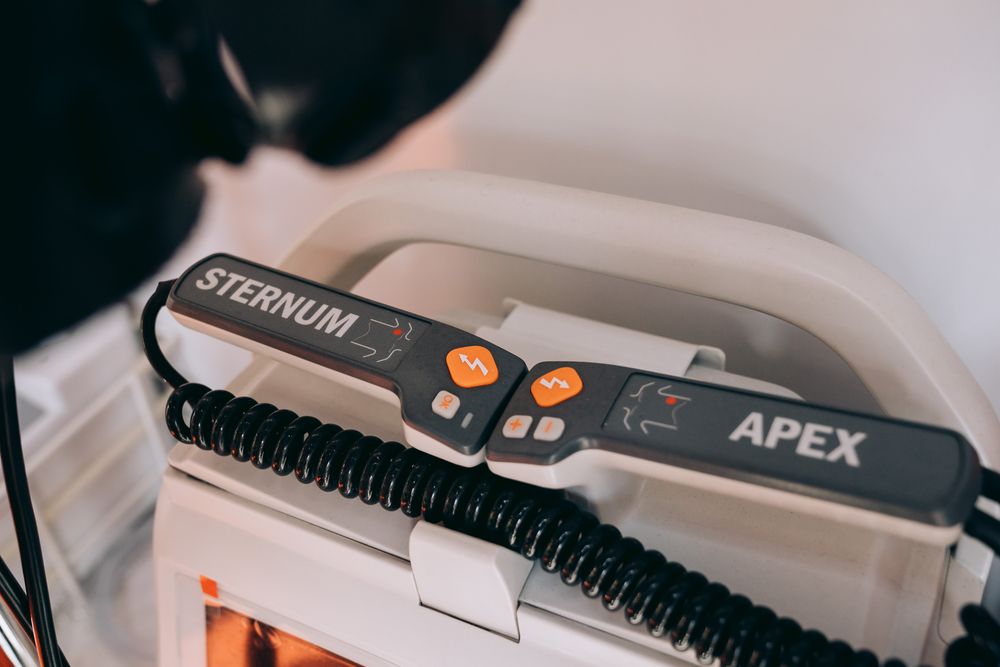
An automated external defibrillator is designed to be used by ordinary people, not just medics. Once switched on, it gives clear spoken instructions and will only deliver a shock if the heart rhythm needs one, so it is safe to use. The general steps are:
- Turn the AED on and follow the voice prompts.
- Attach the pads to the casualty's bare chest exactly as shown on the diagrams.
- Stand clear while the device analyses the heart rhythm and do not touch the casualty.
- If a shock is advised, make sure everyone is clear, then press the button when told.
- Resume chest compressions immediately afterwards and keep following the prompts.
Public-access defibrillators are increasingly common in workplaces, shopping centres and community buildings across Ireland. Knowing where the nearest one is, and being willing to fetch and use it, can make the difference between life and death.
How this fits with trained first aid
CPR and AED awareness complements, rather than replaces, formal training. A qualified occupational first-aider learns these skills in depth alongside how to manage bleeding, choking and other emergencies. If you want to understand how many trained responders your workplace should have, read our guide on how many first aiders your workplace needs, and for the legal background see first aid at work and what Irish law requires.
Key takeaways
- Use the DRABC sequence to assess a collapsed casualty safely and methodically.
- If breathing is absent, call 112 or 999, fetch a defibrillator and start chest compressions at once.
- Compress the centre of the chest five to six centimetres deep at 100 to 120 per minute.
- An AED is safe and easy to use, giving spoken prompts and only shocking when needed.
- This awareness supports, but does not replace, training by a qualified occupational first-aider.
The more people who know these basics, the safer everyone is. Building confidence with proper training is the next step, and our online First Aid course from €35is HSA-aligned, self-paced and issued with a certificate the same day, so your team can be ready to act when it matters most.