Manual Handling in Warehouses and Logistics
Few sectors lift, lower, push and pull as relentlessly as warehousing and logistics. A single picker can handle thousands of items in a shift, and the cumulative strain is exactly the kind of risk Irish manual handling law exists to control. Here is how to keep a busy operation moving without breaking your people.
Why warehouses are a manual handling hotspot
Warehouses combine almost every risk factor in the book. Loads are constant, deadlines are tight, and the same movements repeat all day. Whether it is e-commerce fulfilment, distribution or cold storage, the people on the floor face an unusually high exposure to handling injury.
Irish law treats this seriously. Under the Safety, Health and Welfare at Work Act 2005 and the Safety, Health and Welfare at Work (General Application) Regulations 2007Chapter 4 of Part 2, employers must first try to avoid hazardous manual handling, then assess and reduce whatever remains. In a warehouse, that duty is a daily, operational one — not a paperwork exercise filed away and forgotten.
In logistics, no single lift is the problem. It is the five-hundredth lift, performed while tired, in a hurry, into an awkward space, that does the damage.
The biggest risks on the warehouse floor
Repetitive lifting and order picking
Picking involves continuous reaching, bending, twisting and lifting, often to meet a productivity target. The weights may be modest, but the sheer repetition turns minor strains into the chronic musculoskeletal disorders described in our guide to common manual handling injuries.
Pallets and bulk loads
Building and breaking down pallets means handling items at floor level and above shoulder height — the two worst zones for the spine. Shrink-wrapped, stacked and unstable pallet loads add their own hazards, especially when a top layer shifts unexpectedly.
Loading and unloading
Stripping a trailer or container is intense, repetitive work, frequently in confined spaces with limited headroom and no room to brace properly. Add awkward or damaged packaging and the risk climbs fast.
Manual Handling training from €35
Self-paced, HSA-aligned, certificate the same day — €35 per person.
Fatigue: the hidden multiplier
Fatigue deserves special attention in logistics. As a shift wears on, technique slips, concentration drops and small shortcuts creep in. A worker who lifted carefully at 8am may be snatching loads and twisting by mid-afternoon. Long shifts, night work, peak-season pressure and rushed targets all accelerate this decline.
Managing fatigue is therefore a genuine handling control. Realistic targets, sensible shift lengths, regular breaks, task rotation so the same muscles are not used all day, and adequate staffing for heavy jobs all keep technique intact when it matters most.
Handling aids that take the load
The smartest warehouses lift as little as possible by hand. Mechanical and powered aids should be the first line of defence, not a last resort:
- Pallet trucks and electric pallet trucks for moving palletised loads instead of carrying boxes.
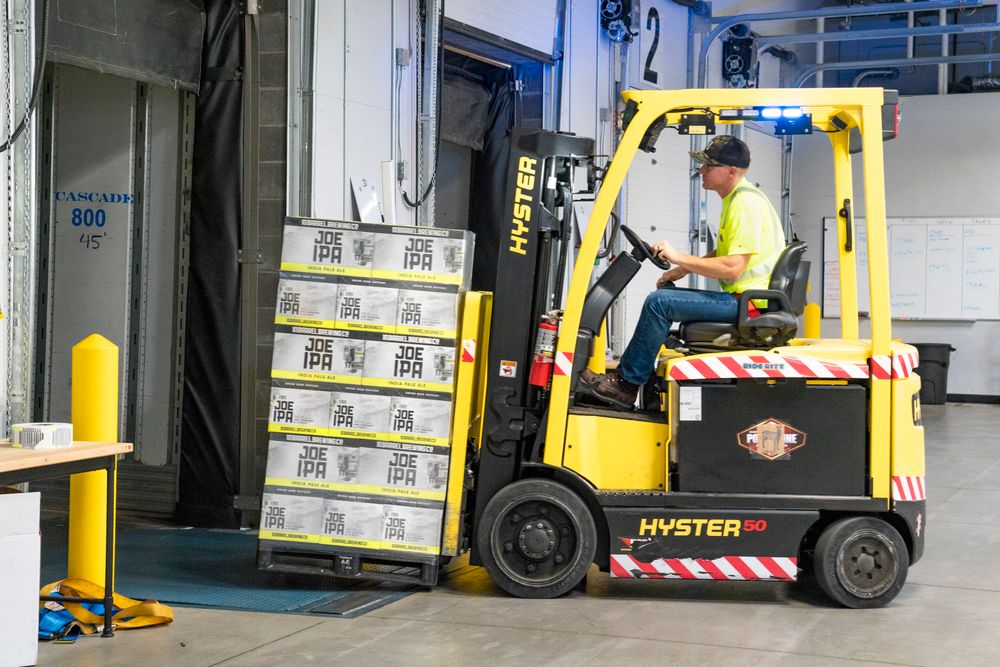
- Forklifts and reach trucks for storing and retrieving stock at height (operated only by trained, authorised staff).
- Conveyors, roller tracks and gravity feeds to move goods without carrying them.
- Trolleys, cages and sack trucks for picking and short internal moves.
- Scissor lifts, lift tables and height-adjustable platforms to bring work into the safe zone between hip and shoulder.
- Vacuum lifters and hoists for heavy or repetitive loads such as sacks, drums and large cartons.
Layout and design do half the job
A well-designed warehouse prevents injuries before they can happen. Thoughtful layout removes the awkward movements that cause most damage:
- Store fast-moving and heavy items in the golden zone between knee and shoulder height, so the worst lifts are the rarest.
- Keep aisles wide and clear so aids can be used and there is room to adopt a good stance.
- Use raised pick faces and tilted shelving to cut bending and reaching.
- Position dispatch, packing and pick zones logically to reduce carrying distances.
- Keep floors level, dry and well lit to prevent slips and trips while carrying.
Training pulls it all together
Equipment and layout reduce the risk, but only trained people use them well and recognise when a task has drifted into danger. Every member of warehouse staff should understand sound safe lifting technique, know how and when to use the aids provided, and feel able to flag a job that is too heavy or too awkward.
Our HSA-aligned online Manual Handling course is built for exactly this kind of fast-moving environment. It takes about an hour, is fully self-paced so it fits around shifts, and issues a certificate the same day from just €35 — with automatic discounts for teams.
Key takeaways
- Warehouses combine repetition, awkward zones, time pressure and fatigue — a perfect storm for handling injury.
- The 2005 Act and Chapter 4 of Part 2 of the 2007 Regulations require employers to avoid, assess and reduce the risk.
- Fatigue quietly multiplies risk as a shift goes on — manage targets, breaks and rotation.
- Pallet trucks, conveyors, trolleys and lift tables should do the lifting wherever possible.
- Smart layout keeps heavy items in the golden zone and cuts carrying — and trained staff make it all work.
In logistics, speed and safety are not opposites. Get the aids, the layout and the training right, and a smoother-running warehouse and a healthier workforce tend to arrive together.